



More than 90% of adults carry Epstein-Barr virus (EBV) for life, yet rarely develop disease. But EBV is classified by the World Health Organization as a Group I carcinogen, associated with approximately 1.5% of human tumors, including lymphoproliferative disorders of B-cell origin.
Post-transplant lymphoproliferative disorder (PTLD) is a typical representative of this class of diseases. The current first-line treatment is CD20 monoclonal antibodies, but up to 30% of patients do not respond to this treatment, and the mortality rate among non-responders exceeds 90%.
A key question emerges: Why does CD20-targeted therapy fail? Is there a more thorough B-cell depletion strategy?
Research Background: EBV's Survival Strategy
After EBV infects B cells, it drives B-cell differentiation in the germinal center, ultimately latent in resting memory B cells. This process involves a cycle of infection, differentiation, latency, and reactivation.
CD20 monoclonal antibodies can clear mature B cells in peripheral blood, but have limited effect on B-cell precursors in the bone marrow. These precursor cells have low CD20 expression and may become a "safe haven" for viral escape.
Research Objective: Finding a Better B-Cell Depletion Strategy
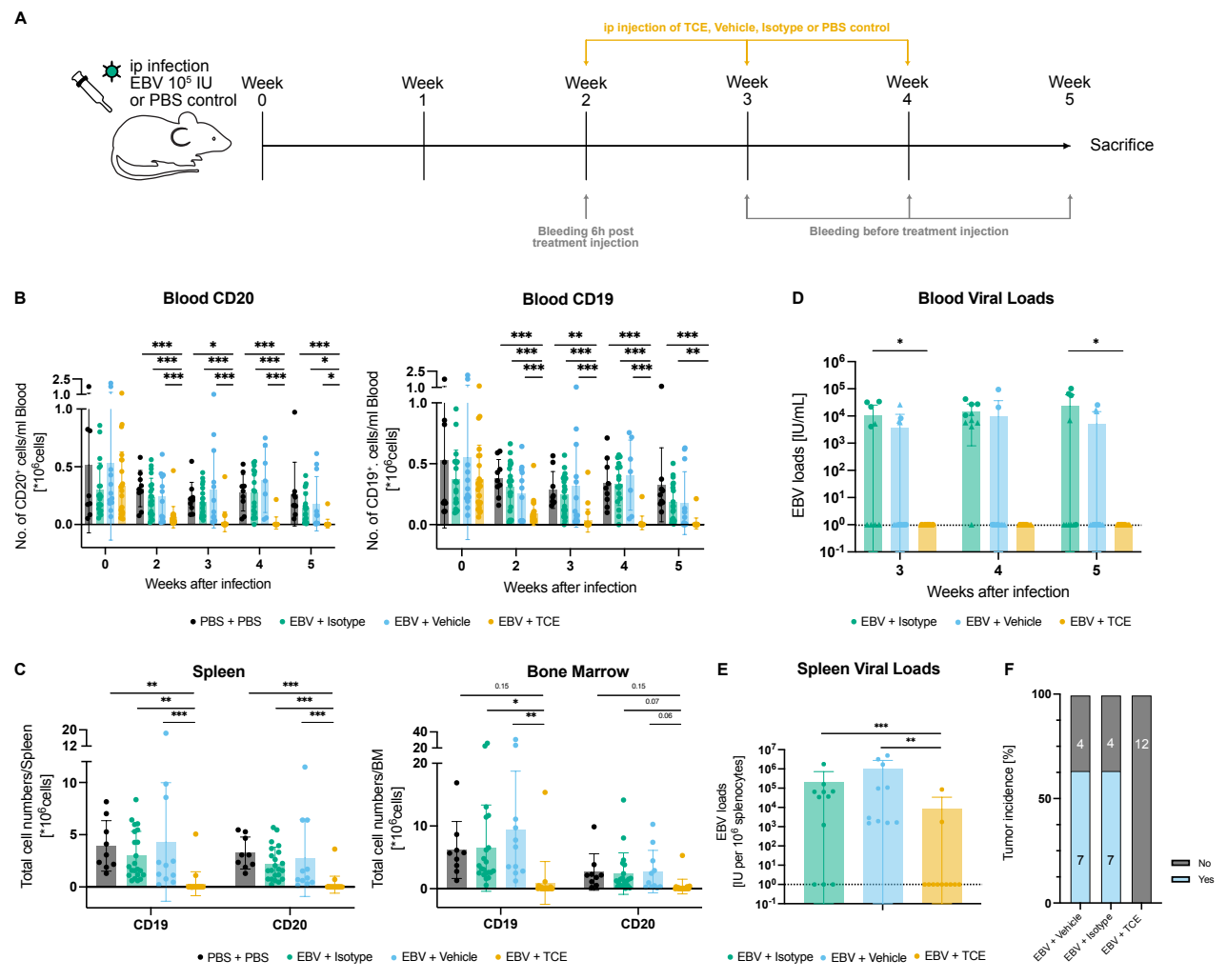
This study aims to compare the efficacy of CD20×CD3 bispecific T-cell engagers (TCE) versus conventional CD20 monoclonal antibodies in the prevention of EBV-associated lymphoma.
The design concept of TCE is different: it simultaneously binds CD3 on T cells and CD20 on B cells, directly recruiting cytotoxic T cells to the vicinity of target cells, independent of T-cell receptor specificity.
Theoretically, this "forced" killing is more thorough than the passive clearance by monoclonal antibodies. However, its actual effect in EBV infection and lymphomagenesis previously lacked systematic study.
Research Methods: Humanized Mouse Model
The research team used humanized NSG mice—human CD34+ hematopoietic stem cells transplanted into immunodeficient mice to reconstitute the human immune system.
The experimental procedure was divided into three steps:
- Mice were infected with EBV to establish latent infection
- Two weeks later, weekly antibody treatment was initiated
- Viral load and tumor formation were assessed at the fifth week after infection
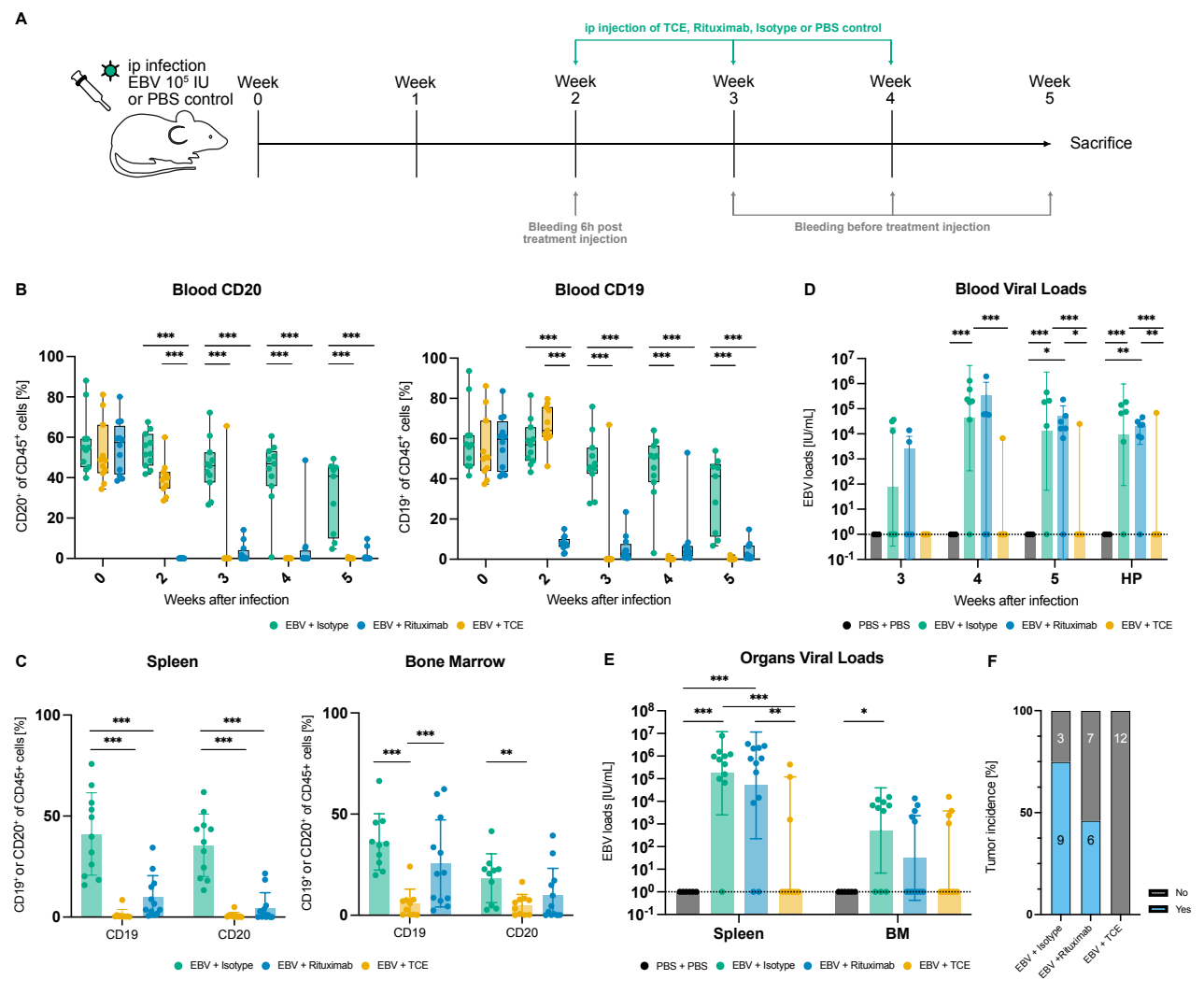
Treatment groups included CD20 TCE, CD20 monoclonal antibody, isotype control, and uninfected group. Notably, the molar dose of the monoclonal antibody group was more than 20 times that of the TCE group, ensuring a fair comparison.
Core Findings: TCE Significantly Superior to Monoclonal Antibody
The results differed significantly. Tumor incidence: No lymphoma occurred in the TCE group, whereas nearly 50% of mice in the monoclonal antibody group developed tumors. Blood viral load: The TCE group remained undetectable throughout the experimental period, while the monoclonal antibody group was comparable to the control group, with persistently high viral load.
Why is the difference so great? The key lies in the depth and breadth of B-cell depletion.
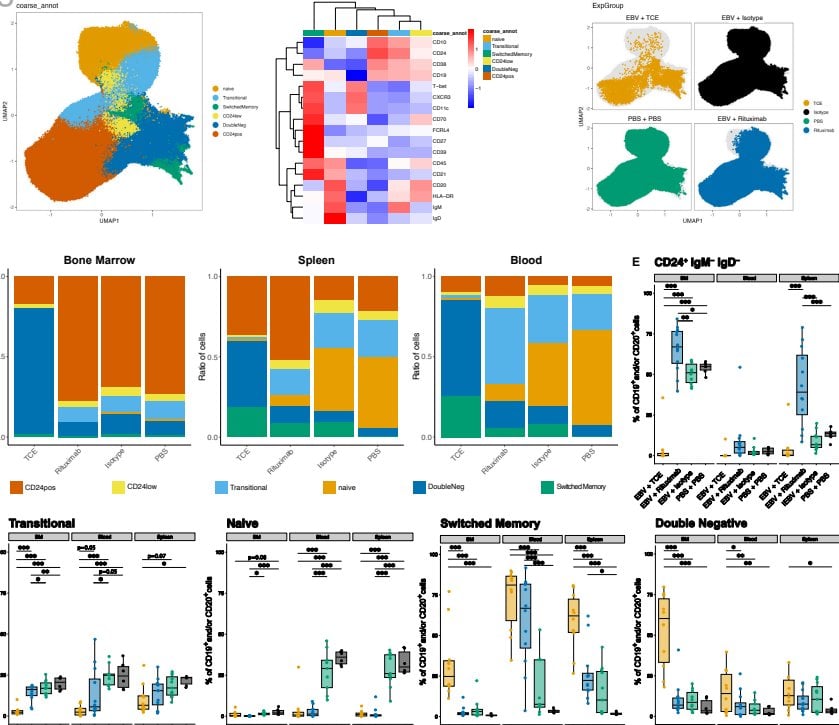
Monoclonal antibodies mainly clear peripheral mature B cells, with CD24+ precursor B cells in the bone marrow almost unaffected. TCE is different: it not only clears mature B cells but also deeply depletes precursor B cells and transitional B cells in the bone marrow.
Although these precursor B cells have low CD20 expression, they can be infected by EBV in in vitro experiments. During B-cell depletion therapy, when conventional targets (mature B cells) are reduced, precursor B cells may become a "replacement host" for viral reinfection.
Innovations and Breakthroughs
The core value of this study lies in identifying a previously overlooked EBV reservoir—CD24+ precursor B cells in the bone marrow.
The traditional EBV life cycle model holds that the virus mainly infects naive B cells and memory B cells. However, this study demonstrates that precursor B cells can also be infected by EBV and are significantly associated with viral persistence during B-cell depletion therapy.
This explains why monoclonal antibody treatment is prone to relapse: it clears the "visible" mature B cells but leaves the "invisible" precursor cells as a viral stronghold.
Practical Significance and Prospects
For clinical practice, this study suggests that bispecific TCE may become a new option for EBV-associated lymphoproliferative disorders, especially for patients who have failed monoclonal antibody treatment.
But TCE is not without cost. In the study, weight loss and cytokine release were observed in mice after the first dose, which are typical manifestations of excessive T-cell activation. How to balance efficacy and toxicity is an issue that must be faced in clinical translation.
The study also raises new questions: If precursor B cells are indeed involved in persistent EBV infection, would strategies targeting earlier B-cell markers (such as CD19) be more effective?
Summary and Reflections
This study, using rigorous preclinical data, reveals the critical role of B-cell depletion depth in the prevention of EBV-associated lymphoma. It not only compares the advantages and disadvantages of two treatment strategies but also refreshes our understanding of the EBV reservoir.
An open question is worth pondering: In an era where monoclonal antibody treatment is generally effective, have we underestimated the clinical value of "deeper depletion"? For EBV-associated diseases, is the goal of treatment to control the virus or to completely eliminate all cells that could potentially be infected? The answer may reshape the design logic of future B-cell-targeted therapies.