


A phase 2 randomized trial shows that in people who started antiviral treatment early, two long-acting broadly neutralizing antibodies can delay viral rebound during an analytical treatment interruption and allow some individuals to maintain off-treatment control for longer. The resistance profile of the rebounding virus and baseline immune status together explain this difference.
Research Background
Antiretroviral therapy (ART) can block HIV spread but cannot clear the latent viral reservoir. These proviruses, integrated in resting memory CD4+ T cells, can reignite systemic infection once treatment is stopped.
The reservoir contains both intact and defective proviruses. The intact reservoir decays extremely slowly under long-term treatment, with a half-life of approximately 4.5 years. How to make viral rebound occur later after treatment cessation is a key question in cure research.
Several previous small studies suggested that broadly neutralizing antibody (bNAb) treatment may accelerate clearance of infected cells and delay rebound. However, randomized double-blind controlled evidence was lacking, and the evolutionary patterns of rebounding virus were unclear.
Research Objectives
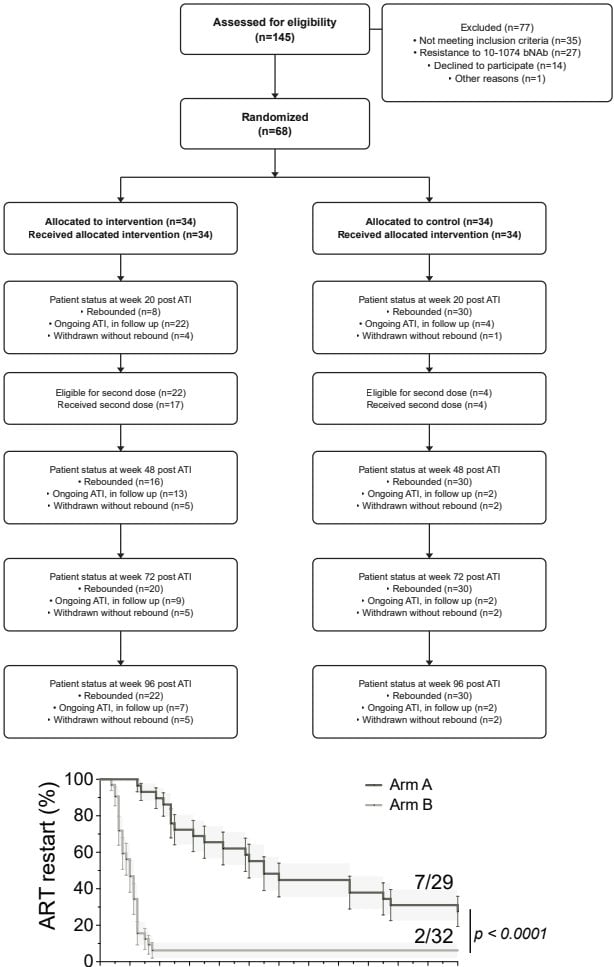
The RIO trial is an ongoing phase 2 double-blind randomized placebo-controlled human trial. The study enrolled 68 men, all of whom started ART during primary or early infection.
Participants were randomized 1:1: group A received two doses of long-acting bNAbs 3BNC117-LS and 10-1074-LS, and group B received saline, followed by an analytical treatment interruption (ATI).
The primary clinical endpoints have been published separately, showing that the bNAb group had significantly delayed viral rebound and prolonged off-treatment control. This paper reports the prespecified secondary analyses and exploratory analyses, focusing on viral reservoir composition, antibody sensitivity, and their relationship to rebound dynamics.
Research Methods (Brief)
Researchers collected peripheral blood mononuclear cells before the intervention and estimated reservoir size using two methods: ddPCR and Q4PCR. ddPCR is more sensitive but cannot confirm sequences; Q4PCR can directly determine whether a provirus is intact but has lower sensitivity.
For envelope (env) sequences from the reservoir and from rebound sources, researchers constructed pseudoviruses and tested their neutralization sensitivity to autologous IgG, 3BNC117, and 10-1074 in TZM-bl cells.
They also compared the numbers of intact and defective proviruses at baseline and before rebound, and used Cox proportional hazards models to analyze the association between time to rebound and baseline antibody sensitivity. Note that the autologous antibody activity analysis was not prespecified in the protocol and is an exploratory analysis.
Key Findings
Baseline reservoir sizes were similar between the two groups. The geometric means of intact proviruses measured by ddPCR were 8.58 and 6.94 per million CD4+ T cells, respectively, with no statistically significant difference.
Rebounding viruses rarely overlapped with dominant intact clones in the reservoir. Among 33 intact latent clones from 9 participants in the control group, only 2 overlapped with rebound sequences. This phenomenon cannot be fully explained by autologous antibody suppression.
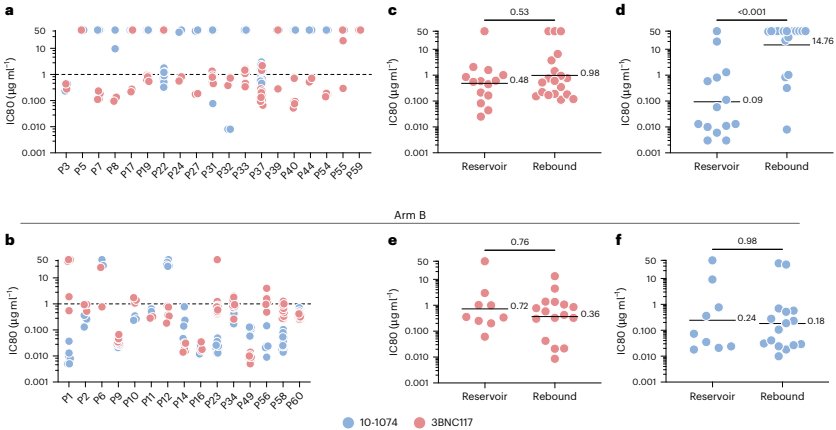
The key difference emerged in resistance selection. In group A, the geometric mean IC80 of rebounding virus to 10-1074 rose from 0.09 in the reservoir to 14.7 µg/ml, with most being fully resistant (P<0.001). In contrast, the difference for 3BNC117 did not reach significance (P=0.53).
Baseline autologous antibody activity correlated with off-treatment control. Among 6 participants in group A with autologous neutralizing activity, the mean time from treatment interruption to ART restart was 108 weeks, versus only 27.5 weeks for the other 13 (P=0.008). Baseline reservoir sensitivity to 10-1074 was significantly correlated with off-treatment time (r=−0.79).
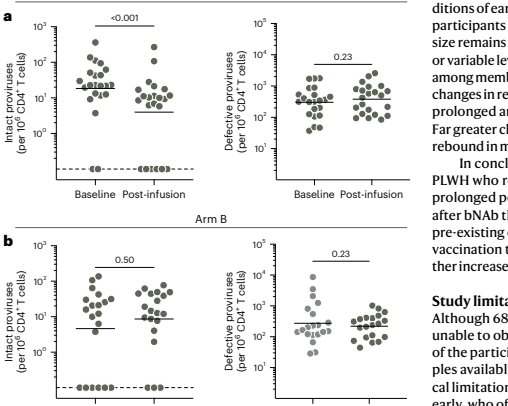
Regarding reservoir dynamics, intact proviruses in group A decreased significantly after bNAb treatment, with an estimated half-life of 36 weeks; defective proviruses showed no change. No measurable reservoir changes were observed in group B.
Innovations or Breakthroughs
This is the first human trial to systematically characterize rebounding virus evolution and reservoir dynamics during bNAb treatment within a randomized double-blind placebo-controlled framework.
The study proposes that rebound mostly occurs under a "functional monotherapy" state—the virus escapes 10-1074 while 3BNC117 concentrations have fallen to subtherapeutic levels. This explains why breakthrough occurs even with combined antibodies.
More importantly, the study links baseline humoral immunity with long-acting antibody exposure, suggesting that the two together shape post-treatment rebound dynamics rather than a single factor determining the outcome.
Practical Implications
For clinical practice, these results support exploring antibody combination strategies in early-treated populations and suggest that baseline autologous antibodies and CD8+ T cell status could serve as potential stratification indicators.
For translational research, although the accelerated decay of the intact reservoir is a correlative observation, it provides human线索 for whether antibodies can alter the reservoir. The study also notes that the magnitude of reservoir change is insufficient to explain differences in time to rebound.
The limitations are equally clear: 33 participants could not provide sequences due to too-small reservoirs, sampling was limited to peripheral blood, and all participants were male and predominantly white, so extrapolation of conclusions requires caution.
Summary and Reflections
The RIO trial shows that long-acting bNAbs can provide a substantial proportion of early-treated individuals with prolonged off-treatment control, and that baseline autoimmunity and antibody sensitivity are important correlative factors. Rebound is not a random event but the result of viral selection under antibody pressure.
If delayed rebound depends more on the host's pre-existing humoral immunity, would pre-strengthening this immunity through vaccines or immunomodulation be more effective than simply increasing antibody doses? This may be a question worth answering in the next stage of research.