


In the randomized phase II ImmunoPRISM trial, patients with high-risk smoldering multiple myeloma received a fixed course of the BCMA×CD3 bispecific antibody teclistamab, achieving a complete response rate of 77.8%, compared with 0% in the lenalidomide-dexamethasone control group; the minimal residual disease negativity rate at 10⁻⁵ sensitivity was 82.2%, and the 2-year progression-free survival rate was 92% versus 49%. These results suggest that T-cell redirecting intervention during the relatively immunocompetent premalignant phase may achieve deeper remissions than in the relapsed/refractory setting, but follow-up duration is not yet sufficient to determine whether it can prevent progression to symptomatic myeloma.
Research Background: Why Intervene When the Disease Has "Not Yet Manifested"
Smoldering multiple myeloma (SMM) is an asymptomatic plasma cell neoplasm that shares some genomic features with multiple myeloma, but has lower tumor burden, lower genomic complexity, and relatively intact immune function. Patients with high-risk SMM are at high risk of progression to symptomatic myeloma.
The standard approach in the past was watchful waiting until symptoms appeared before treating. In 2025, based on the AQUILA trial results, daratumumab became the first drug approved for high-risk SMM; previously, phase III studies of lenalidomide with or without dexamethasone also showed superiority over observation.
However, these lower-intensity treatments still result in disease progression, most likely because the depth of remission is insufficient. Although more intensive combination regimens can deepen remissions, they still have not brought about a cure.
Teclistamab is a BCMA-targeting bispecific T-cell engager antibody that has been approved for relapsed or refractory multiple myeloma (RRMM). In MajesTEC-1, the median progression-free survival (PFS) was 11.8 months, complete response (CR) or better was 39.4%, and the minimal residual disease (MRD) negativity rate was 26.7%. In earlier lines of treatment, its efficacy appears to be better.
This gives rise to a hypothesis: using T-cell redirecting therapy in the high-risk SMM phase, where tumor burden is lower and host immunity is more intact, may achieve deeper remissions than in advanced disease.
Research Objective: Head-to-Head Comparison with Lenalidomide-Dexamethasone
ImmunoPRISM is a multicenter randomized phase II study comparing the efficacy and safety of a fixed course of teclistamab versus lenalidomide-dexamethasone (Rd) in high-risk SMM. The primary endpoint is the CR rate, i.e., the proportion of patients achieving CR or better.
The study also evaluates secondary endpoints including MRD negativity rate, PFS, duration of response, and time to progression, and explores biomarkers associated with response and resistance.
Research Methods: Safety Run-in Plus 2:1 Randomization
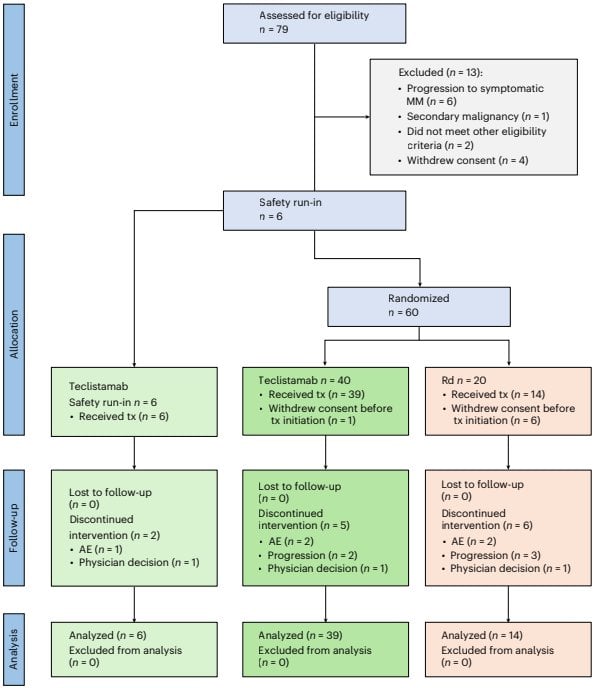
The study enrolled 64 patients with high-risk SMM from April 2023 to July 2025. The first 6 patients entered a safety run-in, receiving a lower cycle 1 dose (720 μg/kg), followed by protocol-specified step-up.
Due to the observed efficacy signal, and with the aim of reducing cumulative exposure in the precursor disease population, the protocol was amended: the maximum duration of teclistamab treatment was shortened from 24 cycles to 12 cycles (15 months). The Rd group received lenalidomide 25 mg (days 1–21) combined with dexamethasone 40 mg for a total of 12 cycles; from cycles 13–24, this was changed to lenalidomide monotherapy 15 mg.
Patients were randomized 2:1 to teclistamab or Rd. As of the data cutoff of May 26, 2026, 59 patients received treatment and were included in the primary analysis: 45 in the teclistamab group (including the safety run-in) and 14 in the Rd group. The median age was 65 years, 39% were female, the median bone marrow plasma cell infiltration was 25%, and 44.1% carried high-risk cytogenetic abnormalities.
Core Findings: Dual Differences in Remission Depth and PFS
At a median follow-up of 24.5 months, 29 of 39 patients (74%) randomized to teclistamab achieved CR or better, compared with 0% in the Rd group. After including the safety run-in cohort, 35 of 45 teclistamab-treated patients achieved CR or better, for a CR rate of 77.8%.
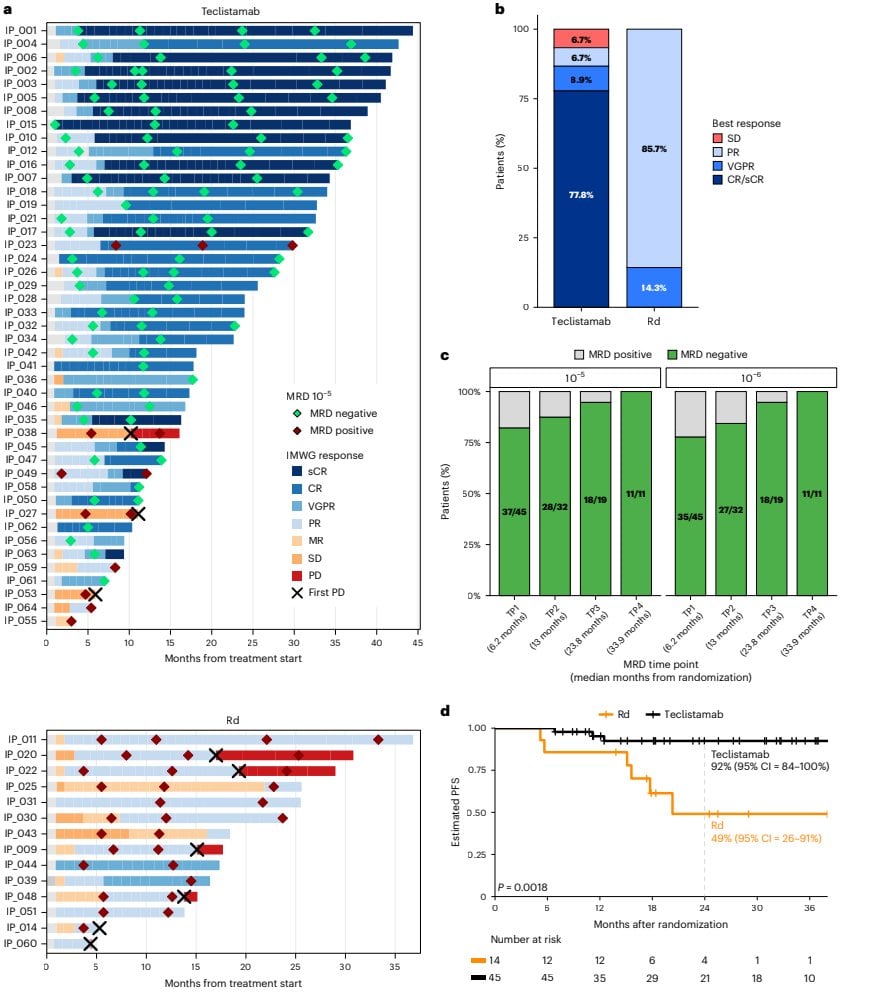
The gap in MRD negativity rates was similarly pronounced. At 10⁻⁵ sensitivity, 37 of 45 teclistamab-treated patients (82.2%) achieved MRD negativity, compared with 0% in the Rd group; at 10⁻⁶ sensitivity, the rate was 77.8%. The median time to achieving MRD negativity was 6.2 months. Among 28 patients who were MRD-negative at first assessment and had serial testing, MRD-negative status was still maintained in 100% at the most recent assessment.
Median PFS was not reached in the teclistamab group, versus 20.3 months in the Rd group (log-rank P = 0.002). The 2-year PFS rates were 92% and 49%, respectively. Duration of response was also significantly superior: the probability of maintaining response at 24 months was 100% in the teclistamab group and 49% in the Rd group.
In terms of safety, the incidence of cytokine release syndrome (CRS) in the teclistamab group was 71.1%, all grade 1–2, with no grade 3 or higher events; no immune effector cell-associated neurotoxicity syndrome (ICANS) was observed. Grade 3 infection rates were similar between the two groups (20% versus 21%), with no treatment-related deaths.
Innovation: "Immune Interception" in Precursor Disease
The most noteworthy aspect of this study is not the bispecific antibody itself, but its use in the early phase of the disease.
In the relapsed/refractory setting, the CR rate of teclistamab monotherapy is approximately 39.4%, and in real-world cohorts, CR or better is 20–29%. In contrast, in this study, patients with high-risk SMM had a CR rate of 77.8% and an MRD negativity rate of 82.2%, approaching or even exceeding the data of some combination regimens in earlier lines of treatment.
The study also suggests that the depth of molecular clearance achievable with monotherapy may not necessarily require the additional treatment burden brought by combination regimens. In the GEM-CESAR study, after carfilzomib-lenalidomide-dexamethasone induction followed by transplantation, the MRD negativity rate was approximately 60%, but only 31% maintained it at 4 years; the preliminary MRD negativity rate of quadruplet combination regimens was also approximately 60%.
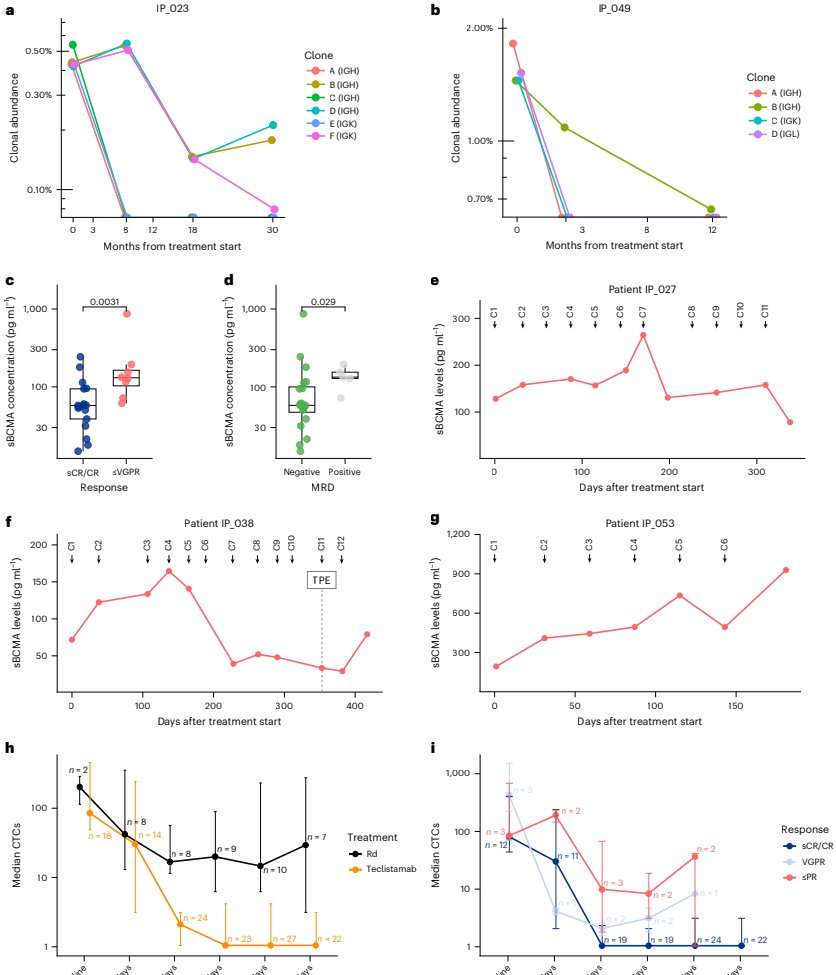
Another innovation is the exploration of resistance mechanisms. Among 3 primary non-responders, whole-genome sequencing found no BCMA mutations, structural variants, or antigen loss. Higher baseline soluble BCMA (sBCMA) was associated with poorer depth of response and persistent MRD positivity, but sBCMA levels in primary non-responders were below the previously proposed resistance threshold, suggesting that soluble antigen burden is insufficient to fully explain primary resistance.
Practical Implications: The Possibilities and Boundaries of Moving Treatment Earlier
For clinical practice, this study proposes a direction: using T-cell redirecting therapy in the high-risk SMM phase may achieve deep molecular remissions with manageable safety. The grade 3 infection rate did not differ from the Rd group, with no ICANS and no deaths, contrasting with the higher infection and neurotoxicity burden in the RRMM setting.
For translational research, it suggests the need for integrated biomarker studies in the precursor disease phase to distinguish antigen-dependent resistance from immune microenvironment-dependent T-cell redirecting failure. Circulating tumor cells (CTCs) declined more markedly during teclistamab treatment and correlated with depth of response, and may serve as a complementary marker of treatment response.
However, conclusions must be cautious. With a median follow-up of only 24.5 months, it is not yet possible to determine whether these deep remissions can translate into durable prevention of progression, nor can conclusions be drawn regarding overall survival benefit or disease eradication. The choice between bispecific antibodies and CAR-T in high-risk SMM remains an open question requiring individualized decision-making.
Summary and Reflections
ImmunoPRISM provides a clear set of data: in high-risk SMM, monotherapy teclistamab was significantly superior to lenalidomide-dexamethasone in CR rate, MRD negativity rate, and PFS, with manageable safety. It has advanced the concept of "immune interception" from theory to the level of a randomized trial.
But a key question remains unresolved: if deep remissions occur in the early phase of the disease, how should we define "cure"? Is it sustained MRD negativity, freedom from subsequent treatment, or long-term non-progression? This requires longer follow-up and specifically designed endpoints to answer.