


ALPK3 gene truncating mutations are an important genetic cause of hypertrophic cardiomyopathy, accounting for approximately 2% of cases. There is currently no curative treatment for these patients. A recent study published in Nature Cardiovascular Research attempted to deliver the full-length ALPK3 gene using an AAV vector, and observed significant functional recovery in animal models and human cardiac organoids.
What is particularly notable about this study is that the therapeutic vector genome reached 5.8 kb, exceeding the conventional packaging limit of AAV of approximately 4.7 kb. How can an "overloaded" AAV vector achieve efficient and safe gene delivery in vivo? The answer involves multiple engineering considerations including promoter selection, expression element optimization, and tissue-specific regulation.
Design Logic of the Overcapacity Vector
The researchers first compared ALPK3 expression efficiency driven by two promoters. The results showed that human ALPK3 expression driven by the cardiac-specific TNNT2 promoter was approximately 5-fold higher than that driven by the broadly expressed CMV promoter.
This gap did not stem from the promoter alone. The vector design also incorporated multiple optimizations: replacing the bovine growth hormone polyA sequence with a 53 bp synthetic polyA signal, and deleting non-regulatory spacer sequences. These modifications reduced the vector genome by 300 nucleotides.
The 5.8 kb genome still exceeds the conventional packaging limit. However, qPCR detection showed no significant difference in copy numbers between the two ends of the vector DNA, and no notable difference between the 5′ and 3′ ends at the RNA level. This suggests that the overcapacity vector is able to deliver the complete full-length sequence in vivo, rather than only partial fragments.
Correct translation and localization of the ALPK3 protein were also verified. Flag-tagged ALPK3 protein accurately reached the M-band of the sarcomere, showing co-localization with ACTN2 and OBSCN. Correct folding and localization of the full-length protein is a prerequisite for functional realization.
Neonatal Prevention and Adult Reversal
The researchers conducted two sets of experiments using a mouse model carrying the patient-derived Alpk3^W1538X mutation.
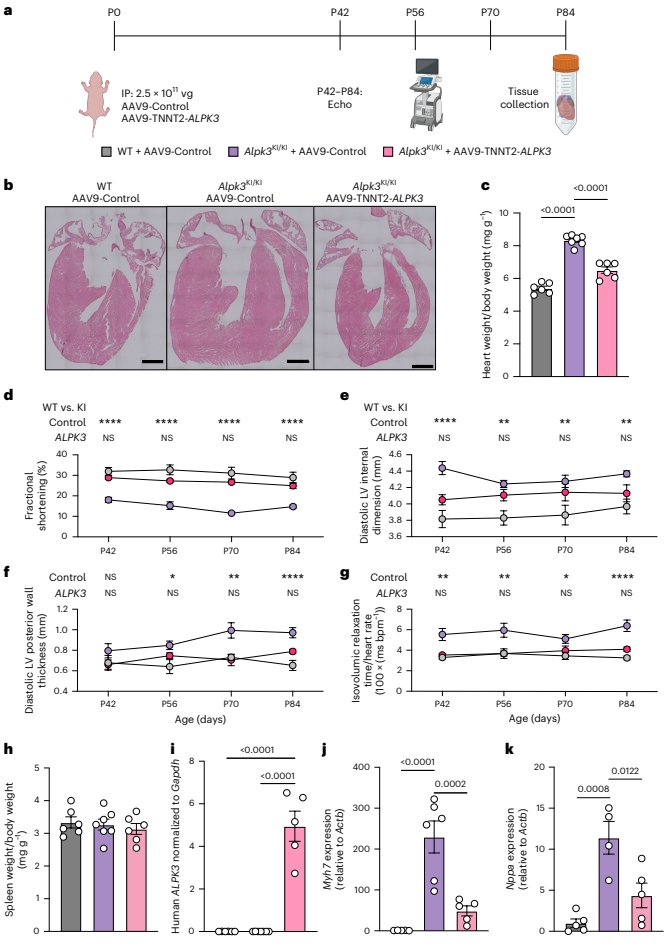
After a single intraperitoneal injection of 2.5×10¹¹ viral genomes during the neonatal period (P0), by 12 weeks of age, heart weight in the treated group was reduced by 63% compared with the control group. Echocardiography showed that various cardiac function parameters in the treated mice recovered to near wild-type levels, including fractional shortening, stroke volume, wall thickness, and diastolic function.
More noteworthy is the adult-stage treatment experiment. At 6 weeks of age, Alpk3 mutant mice already exhibited a clear cardiomyopathy phenotype: cardiac enlargement, and impaired systolic and diastolic function. At this point, after a single tail vein injection of 1×10¹⁴ vg/kg of vector, cardiac function in the treated group recovered to wild-type levels within 4 weeks and was maintained until the 18-week experimental endpoint.
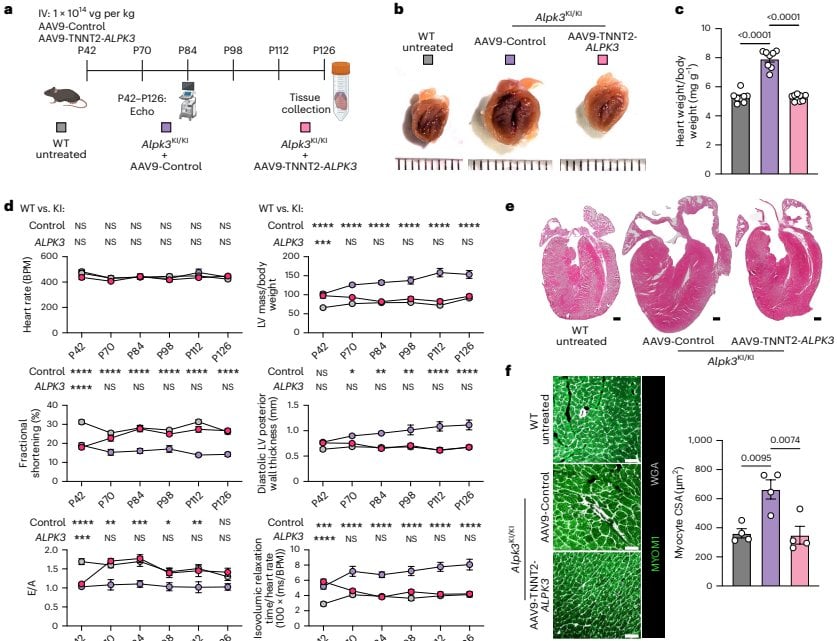
Histological analysis confirmed pathological reversal. Cardiomyocyte cross-sectional area in the treated mice returned to normal, with regular sarcomere arrangement. The researchers noted that because this model already had cardiac hypertrophy at birth, the observed improvement represents true pathological reversal, rather than merely halting disease progression.
It is worth noting that wild-type mice receiving the same treatment showed no significant change in cardiac function, suggesting that ALPK3 overexpression itself does not bring negative effects.
Restoration of Protein Homeostasis
ALPK3 is known to organize a protein quality control hub at the sarcomeric M-band, regulating the turnover of contractile proteins. To investigate the therapeutic mechanism, the researchers performed quantitative proteomics and phosphoproteomics analysis on cardiac tissue.
In mutant mice, 1,612 of approximately 6,000 detected proteins showed abnormal expression. The increased proteins were mostly associated with the A-band, ubiquitin modification, heat shock proteins, and proteolysis, while the decreased proteins involved mitochondria, translation, and amino acid metabolism. After ALPK3 gene therapy, only 81 proteins remained abnormally expressed—that is, 95% of the disease molecular signature was reversed. The reversal rate of the phosphoproteome was even higher, reaching 98%.
The imbalance between thick and thin filament proteins was also corrected. In mutant hearts, all thick filament proteins accumulated, while thin filament proteins decreased. This imbalance is believed to directly cause contractile dysfunction. After treatment, both returned to wild-type levels.
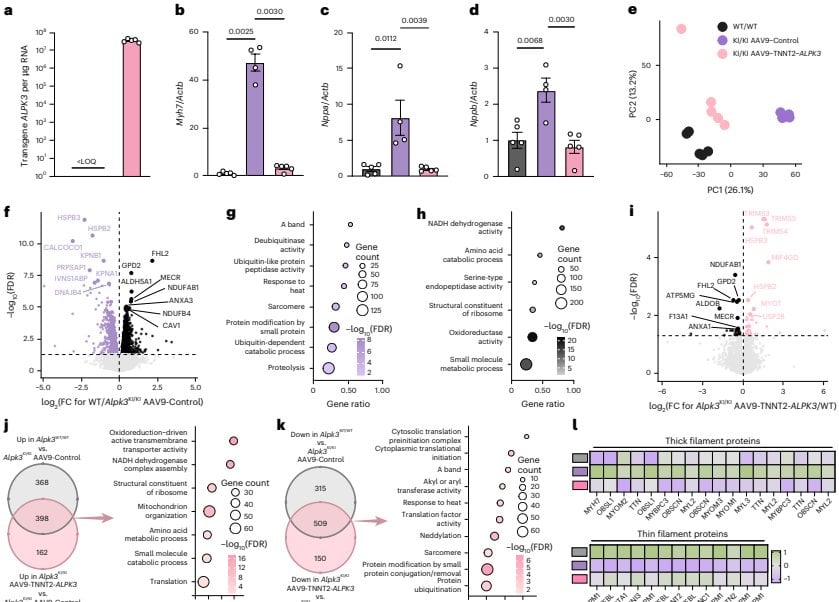
In addition, proteasome activity in mutant hearts was significantly suppressed and was restored after treatment. The sarcomere-localized E3 ligases TRIM54, TRIM55, and TRIM63 were specifically upregulated after treatment. Together, these molecular-level changes point to one conclusion: ALPK3 gene therapy repairs cardiac function by restoring protein homeostasis.
Potential for Indication Expansion
ALPK3 and titin share a protein quality control network at the M-band. TTN truncating variants are the most common genetic cause of dilated cardiomyopathy, accounting for up to 25%. Because the TTN gene exceeds 100,000 nucleotides, far exceeding AAV packaging capacity, conventional gene replacement strategies are difficult to apply.
The researchers hypothesized that delivering ALPK3 might bypass the TTN gene itself and improve function by repairing the shared protein homeostasis pathway. To test this hypothesis, they used human pluripotent stem cell-derived cardiac organoids carrying TTN truncating variants.
Single-nucleus RNA sequencing data showed that TTN truncating variants reduced ALPK3 expression in a gene dose-dependent manner. In functional experiments, the contractile force of TTNtv/+ organoids was significantly lower than that of isogenic controls. After AAV6-ALPK3 treatment, contractile force recovered to wild-type levels, without accompanying abnormalities in other physiological parameters.
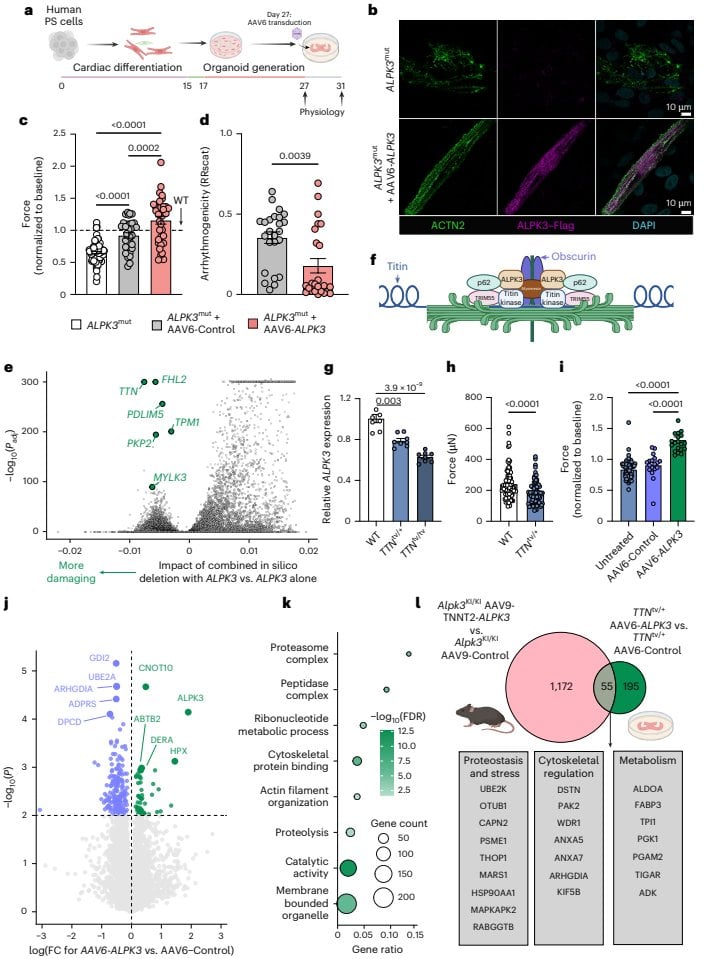
Proteomics analysis showed that differentially expressed proteins between the treated and control groups were concentrated in pathways such as proteolysis, proteasome, and cytoskeletal regulation. Cross-comparison with the mouse data identified 55 shared proteins, whose functions were mostly related to protein homeostasis, cytoskeleton, and metabolic regulation.
The Trade-off Between Full-Length and Miniaturization
One question worth discussing is: given that the full-length ALPK3 vector exceeds conventional packaging capacity, should a miniaturization strategy be chosen? A recent study reported a miniALPK3 construct that achieved partial functional recovery in neonatal mice, but the effect was inferior to the near-complete recovery of the full-length protein in this study.
Miniaturized proteins may also generate junctional neoepitopes, triggering immune responses. This has already been reported in microdystrophin gene therapy. The researchers believe that although reducing the vector genome is an important consideration, the existing data support the use of full-length ALPK3.
This study provides yet another piece of evidence for the feasibility of overcapacity AAV vectors. What differences exist between overcapacity vectors and conventional vectors in packaging, purification, and quality control? Systematic data are still lacking on the effects of genome size on viral particle stability, transduction efficiency, and long-term expression. As gene therapy expands toward larger genes, these questions will increasingly become core issues in process development.